

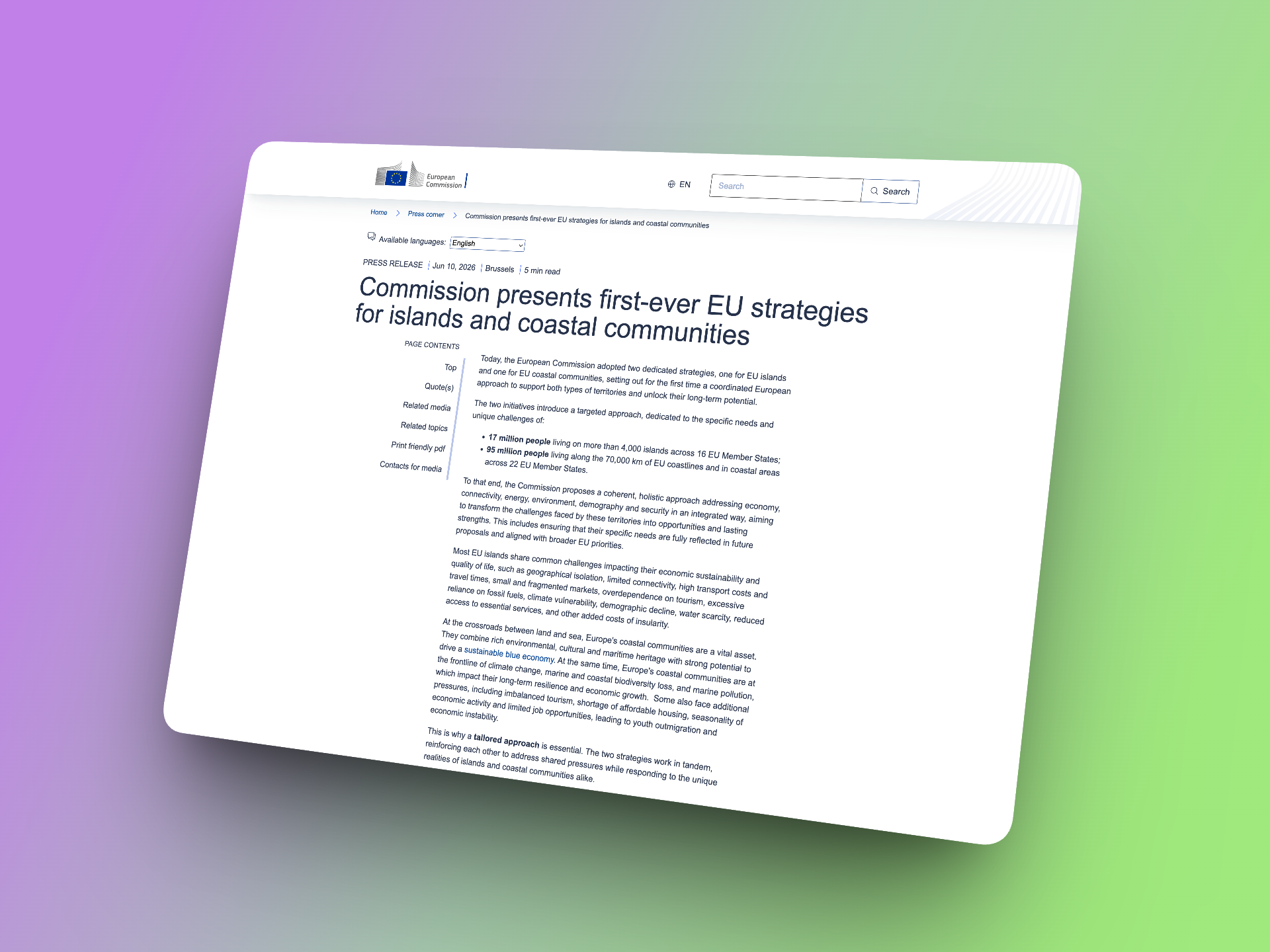
The European Commission has presented a historic package with the first EU strategies dedicated exclusively to islands and coastal communities, setting out a coordinated approach to turn long‑standing structural challenges into long‑term opportunities for economic development and quality of life. These twin strategies cover around 17 million people living on more than 4,000 islands in 16 Member States and about 95 million residents along the EU’s 70,000 km of coastline in 22 Member States.
The EU Islands Strategy aims to systematically integrate island needs into broader EU policies and is structured around four pillars: economic development, connectivity, competitiveness, and innovation; energy security, environmental protection, and climate resilience; communities and demography; and security and crisis preparedness. In practice this means supporting local entrepreneurship and diversification away from overdependence on tourism, improving transport and digital links, accelerating the shift to renewables, strengthening public services (healthcare, education, housing) to counter depopulation, and better preparing islands for natural disasters and maritime risks. The Commission also wants to institutionalize regular dialogue with island stakeholders and encourages Member States to include targeted measures for islands in national and regional plans, including territorial investment tools for integrated local strategies.
The Coastal Communities Strategy is built on three priorities: promoting prosperity through a dynamic and diversified blue economy; strengthening resilience to climate change and other environmental, economic, social and security challenges; and improving liveability in areas ranging from remote fishing villages to major port cities. Proposed actions include giving coastal communities a stronger role in maritime spatial planning, supporting blue bioeconomy clusters and new value chains (such as pescatourism, marine bioeconomy, and offshore renewables), creating a certification system for blue carbon credits, and developing a package of measures to improve risk assessments, investment planning, and capacity for coastal adaptation in cooperation with the European Investment Bank and EU climate and ocean missions. Both strategies are aligned with the European Ocean Pact launched in 2025 and with EU policies on climate, cohesion, and sustainable development, while the outermost regions are excluded as they will be covered by a separate dedicated strategy.
Read the full article on the official website here:
https://ec.europa.eu/commission/presscorner/detail/en/ip_26_1318